Meta-Optomechanics Research
Research areas
Shaping Optical Forces
The ability to control optical forces has transformed modern physics, from optical tweezers and laser cooling to Bose-Einstein condensation. These breakthroughs relied on precise control of the forces exerted by light on matter. Over the past two decades, nanophotonics has shown that structuring matter at scales smaller than the wavelength of light can produce optical responses far beyond those of the constituent materials themselves. This ability to engineer the optical response of an object can also be used to shape how optical momentum is transferred to it, opening new possibilities for manipulating matter with light. Our work explores this regime through precision measurements of radiation pressure and new approaches for shaping optical forces in ultrathin membranes and structured optical surfaces. Laser-driven lightsails push the same physics to an extreme, exploring how radiation pressure could provide both the propulsion and control of ultralight structures over macroscopic distances.


Related Publications:

Compliant reflector / giant optical phase nonlinearity paper (Forthcoming)
Nonlinear & Collective Dynamics
An isolated mode or resonator can often be understood in relatively simple terms. Richer physics emerges when we move beyond this limit - when several modes or elements interact, or when the response becomes nonlinear. Nanophotonic systems provide a striking example: coupling many optical nanostructures can create collective resonances and nonlinear responses that do not exist in a single element. We study related questions across optical and optomechanical systems, from nonlinear and multimode dynamics within individual resonators to interactions among many distributed elements. In the latter, light can mediate long-range coupling between mechanical systems, opening access to collective optomechanical behavior. Across these regimes, we explore how coupling and nonlinearity create new dynamical states, and how these states can be understood and controlled.
Related Publications:
Nonlinear Surface Lattice Resonance in Plasmonic Nanoparticle Arrays (Physical Review Letters, 2017)
Optical Information Processing
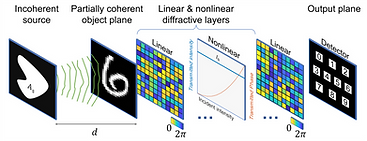
Recent progress in optical information processing is enabling a new class of optical systems in which diffraction and interference are deliberately designed to carry out complex transformations directly on the information carried by light. When such transformations are cascaded, they can build toward a desired output and perform a computational task, with diffractive neural networks providing one example. We design, model, build, and test such systems, and study how far their capabilities can be pushed. A key frontier is optical nonlinearity, where the optical response depends on the light intensity. We investigate how such nonlinearities can be made strong, controllable, and useful for expanding the range of transformations and computational tasks that can be performed directly with light.


Related Publications: